Showing posts with label breathalyser. Show all posts

Thursday, 7 May 2015

Turned away from McDonald's for failing a breathalyser test

A 25-year-old teacher has become the first person to be turned away from McDonald’s in Cambridge for failing a breath test. The branch has just signed up to a police scheme to curb alcohol-related violence.

The teacher was in need of some sustenance after a day at the races and a night on the town. So, like many revellers in the small hours, he sought out the burger chain’s famous golden arches – only to be refused entry because he had drunk more than three times the drink-drive limit.

‘I went to McDonald’s at 2am to get some food and security staff said I had to blow into a breathalyser if I wanted to get in,’ he said.

‘They said I could have got in if I was three times the drink-drive limit or under. I was well over that but I couldn’t believe they said no.’ The man, who insists he did not act aggressively in any way, added: ‘How do you get turned away from McDonald’s for being too drunk?

‘I don’t know why anyone would be there at 2am if they hadn’t been drinking.’ His plans for a Big Mac meal thwarted, he went for a snack at a burger van instead. 
 
141 people were arrested for being drunk in Cambridge last year and 263 were arrested for public order offences.
 
McDonald’s said: ‘At the request of Cambridgeshire Police we are taking part in their pilot scheme. A person’s behaviour will determine the likelihood of them being breathalysed and this should have no impact on the majority of customers.’

The police-funded scheme, which began last Friday, is believed to be the first of its kind in the country. A handful of venues are understood to have signed up,
Cambridgeshire Police said the breathalyser kits were not designed to be used as an entry requirement but as a tool to clamp down on drink-related incidents.
www.alcohol-breathalysers.co.uk


Saturday, 7 February 2015

Drink-driver tries to explain why his car is wrecked to police

A driver was so drunk he told police his car was 'fine' – while sitting at the wheel of a car that had been crashed and rolled over.

The incident was caught on camera and posted on YouTube by Sussex Police. It shows shows PC Andy Green responding to an incident involving a crashed car on Lickfold Road in the village of Fernhurst of West Sussex on the 24th of December, 2014.


PC Andy Green begins by asking the driver, Christopher Squires, if he is okay, having noticed substantial damage to the Volkswagen Polo. The inebriated 28-year-old replies: "Yeah, not too bad mate."

The cop then asks if any injuries have been sustained. "No I'm fine, the car is fine... I've had a few drinks but I'm not drunk," he says, clearly slurring his words.

Squires claims on multiple ocassions throughout the video that he was "just trying to turn the car around" and that it had been damaged before he drove it. He also reveals he only has a provisional licence, before attempting to lie about his identity in a last-ditch attempt to get out of trouble.

Police were easily able to ascertain his real identity. A breathalyser test, meanwhile, found he was more than twice the legal limit of 35 micrograms per 100ml of breath.

Squires pleaded guilty to drink-driving, driving without a licence and driving without insurance at Crawley Magistrates Court on January 6th. He escaped a jail sentence, but was banned from driving for 20 months and had to pay a £320 fine, £85 in costs and a £20 victim surcharge.

Superintendent Jane Derrick said: "Squires made a series of ridiculous attempts to avoid justice. He claimed the damage to his car was old, when it clearly wasn't. He tried to use a fake name, which we were able to quickly prove was not his own.

"He did not have a full driving licence but said that we were wasting his time and taxpayers' money by arresting and questioning him. We will not tolerate
drink-driving and the ban given by the magistrates shows they considered his offences to be serious as well."


www.alcohol-breathalysers.co.uk

Thursday, 1 January 2015

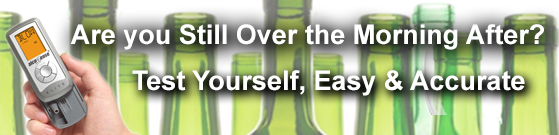
Driver Who Had 3 Drinks Still Over the Limit the Morning After

Daniel Murrell thought he was doing the right thing by spending the night at a friend's house after having a few drinks on Boxing Day evening last year.

He had a maximum of three Captain Morgan's Spiced and by mid evening he had switched to soda water. 'As a dancer, I don't drink a lot - I'm a fit person,' he says. 

The next morning, Daniel got up early to drive home at 6am and got pulled over for speeding as he drove through the deserted streets of Bournemouth 

When breathalysed Daniel was astounded to find out he was over the limit.

'They put me in handcuffs, drove me to the police station and threw me in a cell. I thought, “Hang on, is this real?” I'd never done anything worthy of arrest in my life. But now, here I was, in a police cell.'

With a shortage of police officers on duty over Christmas, and no one to process him, Daniel ended up spending eight-and-a-half hours behind bars, going over and over the consequences of what had just happened.

This is an all-too-common scenario, especially at this time of year, says Liz Brooker, a road safety manager for Lewisham Council in South London, who has run Road Safety GB rehabilitation courses for convicted drink-drivers.

Up to 25 per cent of the drivers on her courses had been stopped the morning after drinking. 'People just don't think about it,' she says.

Even relatively small amounts of alcohol can have an effect - just three glasses of wine could mean you're still over the limit the next morning,

And a variety of factors make people more prone to still being over the limit the next day: women are more likely than men to still have alcohol in their bloodstream, and medication can also have an effect.

Many people think a good sleep, a cold shower and a strong coffee will sort them out after a big night. But nothing can speed up the body's ability to purge alcohol.
Alcohol is absorbed directly into the bloodstream from the stomach and the small intestine and is carried to the liver, which, among its many other jobs, acts as a filter to remove poisons from the body.

The liver produces chemicals called enzymes, which break the alcohol down into other chemicals. These, in turn, are broken down, until all that's left is carbon dioxide and water, which pass out of the body in urine.

This generally takes about an hour for every unit of alcohol - though this rate can vary depending on factors including weight, gender and medication in your system.
Liver disease expert Dr Nick Sheron, head of population hepatology at the University of Southampton, warns there is a range of complicating factors that can play havoc with the one-hour-per-unit calculation, making any attempt to work out when it might be safe to drive the following day a dangerous lottery.

For a start, he says, blood alcohol is determined by your body fat distribution and weight: fatter people actually have less water content in their body. Water in the body helps to dilute alcohol - hence the blood alcohol level would be more concentrated and higher in an overweight person than in a person of normal weight.

Women are also more likely to be caught in the morning-after trap, as it takes them longer to process alcohol. On average, women weigh less than men and, as women's bodies have a lower water content than men's - on average 52 per cent versus 62 per cent - they are less efficient at diluting alcohol, which, drink-for-drink, leaves a higher concentration in their blood.

Finally, women also have lower levels of a chemical called alcohol dehydrogenase - an enzyme that breaks down alcohol in the liver - so it takes a woman longer than a man to get the same amount of alcohol out of her bloodstream. Medication can also complicate things. Aspirin and birth control pills, for example, interfere with the liver's ability to break down alcohol, slowing the process.

And if you drink faster than the liver can do its job, alcohol will simply build up in your blood, potentially leading to a much higher reading if you are breathalysed.
Contrary to the popular myth, eating a big meal before a drinking session won't stop you from getting drunk: all it does is delay the alcohol getting into the bloodstream.
On the other hand, the alcohol in fizzy drinks, such as champagne, can be absorbed more quickly. One dangerous myth is that regular heavy drinkers can 'handle their drink'. It is true, says Dr Sheron, that production of some of the enzymes produced by the liver to break down alcohol are stimulated by alcohol, 'so if you drink regularly, you will metabolise alcohol a little bit quicker than if you don't'.

But only up to a point. 'Once you get to the stage where your liver is damaged by alcohol, you're likely to metabolise it more slowly,' he says.

Another complicating factor, says Ms Brooker, is that most people still don't think about the ABV (alcohol by volume) of what they're drinking, making it impossible to accurately calculate the units. 'They know they've had three glasses, but was it an 11 per cent prosecco or a 14 per cent chardonnay?' she says.

She adds that police will treat you the same as someone who has gone out deliberately to drink and drive.

Like many police forces, Dorset has a policy of naming and shaming drink-drivers. As well as suffering the embarrassment of being exposed in his local paper, Daniel's livelihood was put in doubt. 'It has had a terrible impact on my life and work,' he says.

One year on, he is still having to live with the consequences. Despite having his driving ban reduced after attending a two-day drink-driver rehabilitation course, Daniel won't get his driving licence back until April.
'I am well aware of the message that, if you're going to drink, don't drive. Of course, that makes sense,' he says. 'It can never be worth it.
'But this was the morning-after. I simply had no idea I could be over the limit.'


Friday, 12 December 2014

Scottish Breathalyser

We were emailed this joke and we thought that it was so great we just had to share


www.alcohol-breathalysers.co.uk

Thursday, 23 October 2014

New Alcohol Breathalyer / GPS Tracker Makes a Difference for DUI Offenders

Over in America a Marion County judge says a new alcohol tracker is making a difference by helping to keep DUI offenders sober, at no cost to taxpayers. The program is used as either a condition for release, or part of a sentence.

It’s called “RADAR,” or Real Time Alcohol Monitoring Detection and Recognition.  Offenders are given random Breathalyzer tests throughout the day.  The results are sent in real-time to correction officers. This of course included the location so that the officer can see if they are in a pub.

The unit alerts the offender that it is time for a test by buzzing and lighting up.  The unit also knows if it is the offender that gives the test (im not sure how that is done as I write this)

Right now, more than 200 people are using RADAR in Marion County.  Superior Court Judge Bill Nelson says it’s not only stopping people from drinking—it’s saving on jail space and tax dollars.

“It’s offender funded, so it’s not costing the taxpayer anything. If I throw someone in jail, it’ll cost the county about $52 a day; the offenders are paying for this up to $12 dollars a day,” he said.
“Some of these people need to go to jail, and they will, but the vast majority of these offenders do not need to be incarcerated,” he said.

To read more on this story and view the video please visit the link below

http://fox59.com/2014/10/21/new-alcohol-tracker-makes-a-difference/

www.alcohol-breathalysers.co.uk


Tuesday, 16 September 2014

Pub & Club Goers in Hemel Hempstead Could be Breathalysed

Pub and club-goers in Hemel Hempstead could be breathalysed on their nights out as Herts Police take part in a national alcohol awareness campaign.


Officers will be operating the checks on those who’ve had "one too many" at the town’s Function Rooms and Full House venues.

They will also be carrying out licensing patrols alongside Dacorum Borough Council as part of the initiative, due to run until September 28.

People will be encouraged to drink responsibly, with the main message focusing on the amount of time and police resources that have to deal with the consequences of people consuming too much alcohol.

According to police, when people drink to excess they can start to lose their normal reasoning which leaves them vulnerable to aggression and accidents, while long-term alcohol abuse has a significant health and social impact.

There is also a new telephone counselling service for those who need support for alcohol abuse or dependency which was launched earlier this month.  0300 111 2470

The service will be available on three evenings per week from 6pm to 9pm and on Saturday mornings. Calls are charged at the local rate.

www.alcohol-breathalysers.co.uk

Wednesday, 2 July 2014

EU Backs Future Role for Alcohol Interlocks

Two new EU reports support measures to boost the use of alcohol interlocks in passenger and goods vehicles in the EU. The study that was by TRT (an Italian consultancy) for the European Parliament (EP) even goes as far as recommending legislation.

It says proposals to ensure the statutory use of alcohol interlocks for convicted drink drivers should be put forward within the next five years and that they could make a “relatively important contribution" to the achievement of the EU’s target to halve road deaths by 2020”, by preventing aproximately 6500 deaths caused anually by drink driving in europe.

.Other studies have already shown that the use of alcohol interlocks are extemely effective in cutting repeat drink driving offences. One of these, a Finnish report that was published last year (based on four years of data) showed a re-offending rate of 6% when interlocks were used compared to the usual 30% rate in Finland.

The EP study paints a mixed picture of the use of the technology as a preventative measure in commercial vehicles, the study suggests that mandatory use might offer a near-break-even cost-benefit ratio when used on buses and lorries, although ut says that the same is not true for vans.

The other report by a Dutch research consortium for the European Commission (EC), however, says that compulsory installation in all new commercial vehicles does have a positive cost-benefit ratio, but warns of a wide sensitivity range in its analysis and lack of "stakeholder support".

The issue of cost is a major theme in both reports, though the EC study points out that innovation could be key to mass adoption of the technology especially if in future the devices would become less intrusive and costs came down due to economies of scale in production or technological development the option of making an alcohol interlock a compulsory device in all passenger cars could show a “robust net benefit to society”.

The EP report recommends legislation to harmonise Blood Alcohol Concentration (BAC) limits, reporting procedures and the definition of drink driving across the EU.

Antonio Avenoso, executive director of ETSC, said: “While we agree with many of the suggestions in these reports, both miss the big picture. The fact is that bold EU legislation would, in itself, drive innovation and cost reduction in the market for these devices. “If, for example, the EU made installation mandatory in all commercial vehicles and required their use for all drink driving offenders, then we would see a rush of innovation and new players entering the market to deliver reliable, unobtrusive devices at low cost. We know that alcohol interlock devices work because we have evidence from several EU countries that show reduced re-offending rates. We hope the new Commission and Parliament will take a bolder approach to the deadly, and completely avoidable, problem of drink driving.”